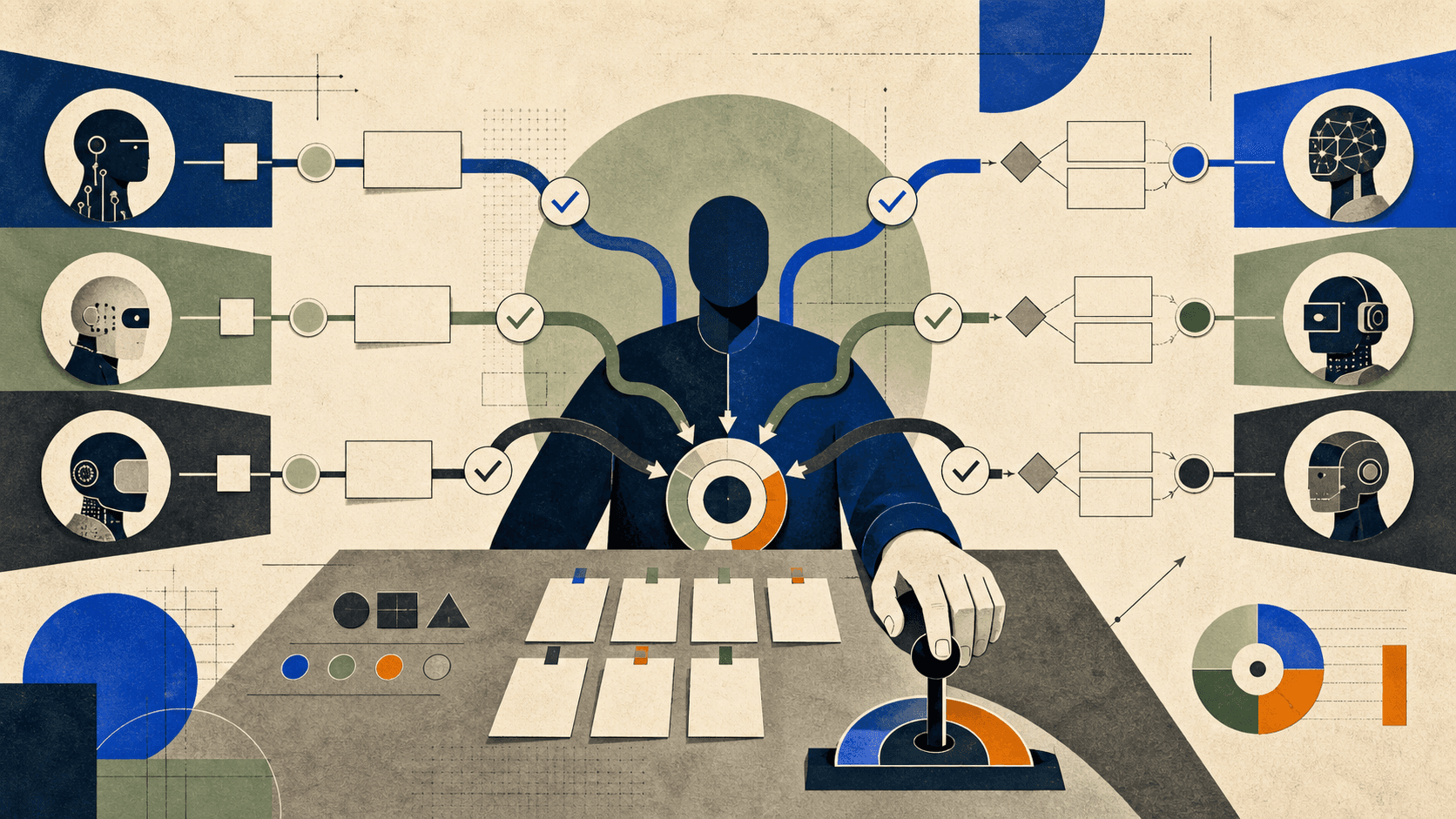
Managing one AI agent can feel like magic.
Managing several AI agents across multiple projects feels more like running a company staffed by brilliant people who have no memory of yesterday, no fear of being fired, and no personal stake in whether the company survives.
The agents can write code, analyze markets, draft articles, review documents, build interfaces, create tests, and suggest strategies. Each may appear remarkably capable when evaluated within the boundaries of a single assignment.
The illusion of autonomy begins to break when those agents must operate together.
One agent makes a technically sensible decision that contradicts the product strategy. Another “improves” a feature without understanding why it was intentionally limited. A third creates a polished explanation based on assumptions nobody verified. Meanwhile, a fourth confidently reports that everything is progressing nicely.
Every individual action can look intelligent while the combined result moves in the wrong direction.
That is when the human becomes indispensable.
The most difficult part of managing AI agents is rarely generating the work. It is maintaining coherence across the work. Someone must remember why the projects exist, which decisions have already been made, what tradeoffs are acceptable, and which apparently efficient shortcut could create a serious problem six months from now.
Today, that someone is still a human.
Intelligence Is Not Responsibility
The AI industry often treats capability as if it naturally leads to authority.
If an AI can complete a task, the reasoning goes, it should eventually be allowed to control the process. If it can control the process, perhaps it should control the project. And if it can control the project, why not allow it to make the important decisions?
Because performing work and accepting responsibility for that work are not the same thing.
An AI agent does not currently experience the consequences of its decisions. It does not lose money when a product fails. It does not face a customer whose trust was damaged. It does not explain a missed deadline to investors, employees, or a family depending on the business.
It does not suffer reputational harm, legal liability, embarrassment, regret, or the lingering realization that it should have known better.
The human does.
Responsibility without consequence is mostly a simulation. An agent can produce language that sounds accountable—“I made an incorrect assumption,” “I should have verified the information,” or “I will improve the process”—but the agent does not actually carry the burden of the failure forward.
The apology costs it nothing.
The lesson may disappear when the context window closes.
Multiple Projects Expose the Problem
The limitations become especially obvious when AI agents work across several projects.
Every project has its own goals, audience, history, constraints, risks, and definition of success. A decision that is appropriate for one project may be disastrous for another. Shared technology does not mean shared strategy. Similar branding does not mean identical customers. Short-term development speed does not automatically create long-term business value.
AI agents are usually very good at optimizing the assignment in front of them. They are less dependable at understanding how that assignment fits into an evolving portfolio of decisions.
They optimize locally.
Humans must think globally.
The agent sees the ticket. The human sees the company.
The agent sees the requested feature. The human remembers the customer conversation that caused the feature to be requested.
The agent sees a faster implementation. The human may recognize that the shortcut creates security, maintenance, regulatory, or reputational risk.
This does not make the agent useless. It makes the agent powerful in the way that every powerful tool is useful: when directed by someone who understands both the objective and the consequences.
AI Can Recommend Without Owning the Outcome
AI agents should increasingly be allowed to research, propose, challenge, test, and execute. They should be encouraged to identify contradictions and argue against weak human assumptions.
Humans do not need AI agents that merely agree with them.
But decision support is different from decision ownership.
An agent can recommend launching a product. It does not have to fund the launch.
It can recommend deleting a system. It does not have to rebuild the customer trust lost when that deletion goes wrong.
It can recommend an aggressive public claim. It does not have to defend that claim years later when a journalist, regulator, customer, or competitor asks for evidence.
This is why authority should be proportional to accountability.
The greater the possible consequence, the more clearly a responsible human must remain involved. Low-risk and reversible actions can be delegated broadly. High-impact, irreversible, financial, legal, security, or public decisions should require deliberate human approval.
That is not an argument against autonomy. It is an argument for earned autonomy.
What Would AI Have to Prove?
Before an AI system can reasonably be trusted with meaningful responsibility, it must demonstrate more than intelligence.
It must maintain reliable memory across time. It must understand cause and effect beyond the immediate task. It must recognize uncertainty, disclose what it does not know, and resist the temptation to manufacture a confident answer.
It must preserve objectives across changing conditions. It must distinguish between following an instruction and serving the larger purpose behind that instruction. It must understand when not to act.
Most importantly, it must be connected to consequence.
What does it mean for an AI to accept responsibility? Can it hold durable obligations? Can it be audited? Can it explain its reasoning consistently? Can it be corrected without simply producing a better-sounding apology? Can society assign liability to it in a meaningful way?
Until those questions have credible answers, humans cannot responsibly surrender control simply because the software appears intelligent.
And even if AI eventually demonstrates those qualities, we should still question whether final human authority ought to disappear.
The Human Role Is Becoming More Important
As AI agents become more capable, human management does not become unnecessary. It changes.
The human increasingly defines intent, establishes boundaries, allocates authority, resolves conflicts, verifies outcomes, and decides which consequences are acceptable.
That is leadership.
The future may not belong to humans who personally perform every task. It will belong to humans who can coordinate intelligent systems without confusing speed for progress, output for judgment, or capability for responsibility.
AI agents can generate extraordinary leverage. They can help a small team operate like a large one. They can shorten development cycles, expand research capacity, and expose opportunities that might otherwise remain invisible.
But leverage amplifies direction. If the direction is wrong, AI helps us travel the wrong way faster.
For now, the AI can do the work.
The human must still decide what work matters, whether it was done correctly, and what happens next.
The human remains in charge because the human still bears the consequences.
Until AI can genuinely accept that burden—not merely describe it—the buck must stop with us.
Perhaps it always should.