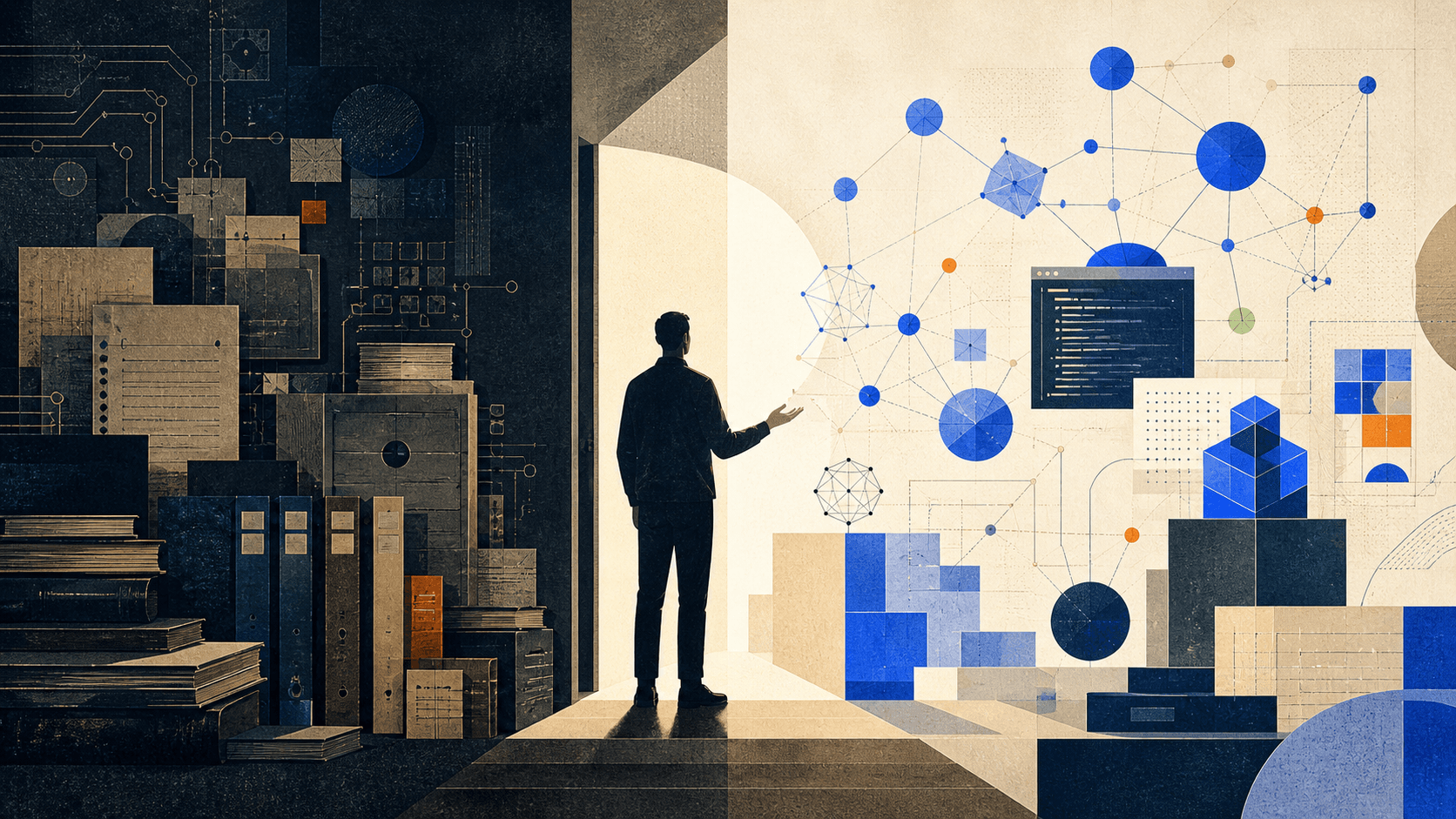
Artificial intelligence did not invent impostor syndrome. It industrialized it.
There is no disputing the rapidly accelerating effect AI—and increasingly autonomous AI agents—is having on people and companies. Every week brings another model that writes better, reasons longer, codes faster, creates richer media, and performs work that recently required a trained professional.
The result is a strange new anxiety spreading across the economy.
Writers wonder whether they can still write. Programmers question whether they are still programmers. Designers watch software create twenty concepts before they have finished naming their first layer. Executives attend one AI demonstration and quietly wonder whether everyone else understands something they do not.
Entire companies are experiencing the corporate equivalent of looking around a meeting and hoping nobody discovers they have no idea what is happening.
AI has placed a superficial layer of impostor syndrome over nearly everyone.
It is superficial because AI has not suddenly made human experience, judgment, or creativity worthless. But it has changed how competence appears. Machines can now produce many of the visible artifacts we once associated with expertise: code, articles, reports, presentations, financial models, images, research summaries, and strategic plans.
The appearance of competence has become inexpensive.
That is unsettling because many careers and companies have been built around producing those artifacts. When an AI system can create in thirty seconds what previously took someone three days, it becomes natural to question the value of the person—or the business—that used to perform the work.
But this is where we must separate the feeling of being an impostor from the reality of becoming obsolete.
AI can create output. It cannot automatically determine which output deserves to exist. It can generate options, but someone must still choose among them. It can recommend a direction, but someone must accept responsibility for the consequences. It can write code, but it does not lose a customer, miss payroll, face a regulator, or explain to investors why the “fully autonomous” system confidently deleted the production database.
Artificial intelligence can manufacture competence faster than it can manufacture accountability.
That distinction is why humans remain in charge—and why the people who learn to direct AI will become far more capable than those who simply compete against it.
We are entering an AI renaissance. Like every renaissance, it rewards curiosity, experimentation, and people willing to learn new instruments. The printing press did not eliminate thought; it expanded who could distribute it. Spreadsheets did not eliminate financial judgment; they made calculations faster and allowed people to model more possibilities. The internet did not eliminate businesses; it reorganized which businesses mattered.
AI is doing the same thing at a greater speed and across more professions simultaneously.
The danger is not that AI will make everyone an impostor. The danger is that some people will allow the feeling of being an impostor to prevent them from participating.
There is comfort in dismissing AI as hype. There is comfort in finding examples where it hallucinates, writes mediocre prose, or produces code that fails. Those failures are real. Anyone who has worked seriously with AI agents has watched one make an impressive plan, execute half of it, forget the original objective, and then declare victory with the confidence of a consultant leaving before implementation.
But judging AI only by its failures is like evaluating the early internet by how slowly a photograph loaded in 1996.
The direction is unmistakable.
AI systems are improving. Tools are becoming more capable. Agents are gaining access to browsers, terminals, databases, applications, and persistent workflows. The unit of value is shifting from answering a question to completing a task. Soon, the meaningful comparison will not be between a human and an AI model. It will be between a human using a coordinated collection of AI agents and a human working alone.
That is not a fair fight.
The same is true for companies. A business that integrates AI into research, software development, customer operations, marketing, analytics, and decision support will move differently from one that treats AI as an experimental chatbot assigned to the innovation committee.
Adding an AI button to the website is not transformation. Purchasing licenses nobody uses is not a strategy. Mentioning AI twelve times in an investor presentation does not make a company technologically modern. That is corporate costume jewelry: shiny from a distance and disappointing under inspection.
Real adoption requires redesigning how work moves.
It means determining which tasks machines can perform, which decisions humans must retain, how results will be verified, where accountability belongs, and how institutional knowledge can be made usable by intelligent systems. It means giving employees permission to experiment while establishing standards for security, accuracy, privacy, and oversight.
Most importantly, it means accepting that the first attempts will be imperfect.
AI agents are less like magical employees and more like extremely fast interns with unlimited confidence, inconsistent judgment, and no fear of being fired. They need clear objectives, useful context, access to the correct tools, observable work, and frequent review. With experience and structure, they become more valuable. Without management, they produce chaos at machine speed.
Harnessing AI does not require everyone to become a machine-learning engineer. It requires people to become capable directors of machine intelligence.
The valuable professional of the next decade will understand the problem, frame the objective, deploy the right combination of human and machine capability, evaluate the result, and take responsibility for the outcome. Expertise will matter, but expertise amplified by AI will matter more.
This is the choice now facing individuals and companies.
Participate in the renaissance, or retreat into the Dark Ages of computer science.
The Dark Ages will not be defined by an absence of computers. They will be filled with computers, cloud subscriptions, dashboards, and software licenses. What will make them dark is the refusal to use the most powerful computational tools available. People will continue doing manually what machines can accelerate. Companies will protect familiar processes while faster competitors redesign the work itself.
The impostor feeling is understandable. Nearly everyone is learning in public. The tools are evolving faster than the courses explaining them. Even the experts are discovering that their expertise has an expiration date unless it continues to grow.
But feeling temporarily unqualified is not evidence that you do not belong.
It is evidence that the world has changed.
The answer is not to pretend to know everything about AI. Nobody does. The answer is to begin using it, testing it, challenging it, measuring it, and developing the judgment required to manage it.
The renaissance is already underway.
You do not need to master all of it today. But you do need to enter the room.