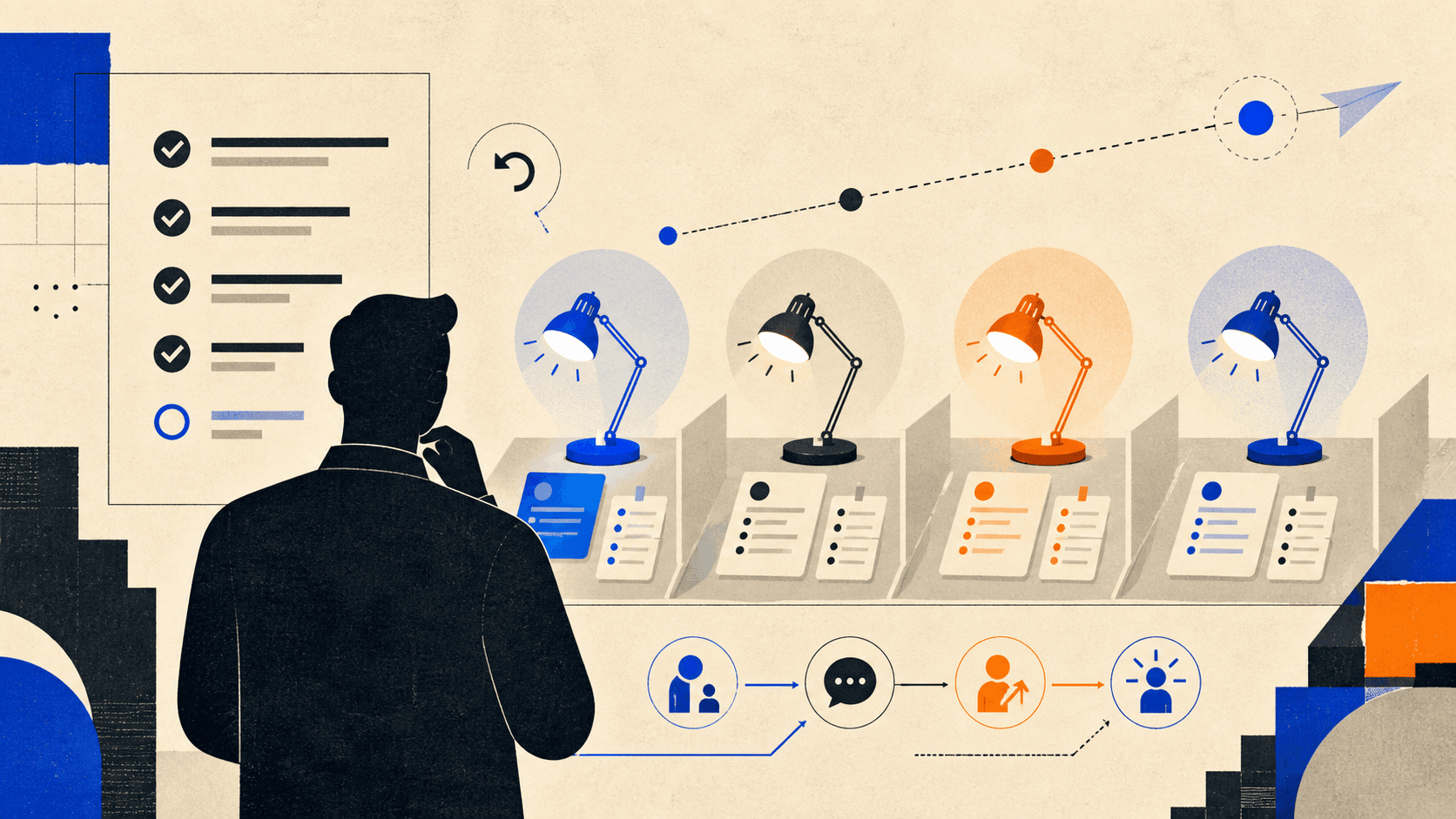
The first mistake people make with AI agents is assuming they have hired a team of seasoned professionals.
They have not.
They have hired interns.
These interns happen to read extraordinarily fast, work through the night, and possess the collected knowledge of much of the internet. They can write code, analyze documents, operate software, conduct research, and occasionally produce something so impressive that you wonder whether your own career has become an elaborate misunderstanding.
Then, five minutes later, the same agent deletes the navigation menu, invents a customer testimonial, and confidently reports that the project is complete.
Welcome to management.
Some AI agents are excellent from the beginning. Give them a clear objective, the right tools, and enough context, and they produce thoughtful work with surprisingly little supervision. They recognize ambiguities, make reasonable decisions, test their output, and tell you when they are uncertain.
These are the interns you immediately begin treating like junior employees.
Most agents, however, behave like talented people on their first day in an unfamiliar office. They may possess the technical ability to complete the assignment, but they do not understand the business, the standards, the history, the personalities, or why “just update the homepage” does not mean rebuilding the entire website in purple.
They lack experience.
The answer is not to declare AI agents useless. The answer is to give them experience.
Intelligence Is Not the Same as Judgment
An intern can be intelligent and still make terrible decisions.
So can an AI agent.
Intelligence helps someone identify possible actions. Judgment helps them choose the right one. Judgment develops through exposure to real situations, feedback, consequences, patterns, and repetition.
An agent may know 40 ways to structure a software application. That does not mean it knows which structure fits your product, team, budget, users, and existing codebase. Without context, it may select the most sophisticated option simply because sophistication looks impressive.
Interns do this too.
Ask an intern to organize a small customer list, and by lunchtime you may have a proposed enterprise data architecture, three workflow diagrams, and a recommendation to migrate the company to software nobody has approved.
The work can be technically competent and completely wrong for the situation.
Experienced managers do not merely assign tasks. They transfer context. They explain what matters, what has already been tried, which constraints are real, where judgment is required, and what a successful result looks like.
AI agents need the same treatment.
Give Agents Real Work, Not Just Instructions
Experience cannot be downloaded through a better system prompt.
Prompts matter. Documentation matters. Examples matter. But experience comes from performing tasks, receiving feedback, correcting mistakes, and encountering variations of the same problem.
If you want an agent to become useful in software development, let it work on progressively more meaningful software tasks.
Start with a contained bug. Then assign a small feature. Ask it to write tests. Let it review an existing implementation. Have it diagnose a failed deployment. Require it to explain its decisions. Show it what passed review and what did not.
Over time, the agent accumulates something resembling organizational experience: patterns, precedents, preferences, failure modes, and standards.
This does not necessarily mean the underlying model permanently learns from every task. The experience may live in project instructions, saved context, decision logs, examples, test suites, evaluation results, or reusable workflows. What matters is that yesterday’s lesson is available during tomorrow’s assignment.
Otherwise, you are managing the first day of the same internship forever.
Good Management Changes the Outcome
When an intern repeatedly fails, the intern may be the problem.
But the manager may also be handing out vague assignments, withholding important information, and reviewing the work only after it has caused a small electrical fire.
The same is true with AI agents.
“Build the feature” is not an adequate assignment.
Which feature? For whom? Why does it matter? What should it integrate with? What must it not change? How will success be tested? Which decisions can the agent make independently, and which require approval?
The clearer the operating environment, the better the agent performs.
This does not mean writing a 70-page instruction manual for every button. It means building a management system: clear objectives, accessible context, bounded authority, observable work, frequent checkpoints, automated tests, and honest evaluation.
A good agent workflow resembles a good internship program. The intern receives responsibility, but not the keys to the building, the company bank account, and permission to “improve anything that looks old.”
Autonomy should be earned through demonstrated reliability.
The Best Agents Still Need Supervision
A brilliant intern can create tremendous value. That does not mean you stop reviewing the work.
Excellent AI agents can research options, write functioning code, find defects, propose strategy, and complete hours of repetitive work in minutes. But they can also misunderstand intent, optimize the wrong metric, overlook a business constraint, or confidently fill missing information with fiction.
Their fluency disguises their inexperience.
A nervous intern usually tells you, “I’m not sure.”
An AI agent may deliver the same uncertainty as a polished executive presentation with seven bullet points and a recommended implementation timeline.
That is why verification matters. The better the output sounds, the easier it is to confuse confidence with correctness.
Agents should be expected to show their work, identify assumptions, test results, disclose uncertainty, and surface decisions that could cause damage. Managers must examine outcomes, not merely admire the presentation.
Build a Bench, Not a Super-Agent
Not every intern is good at everything.
One may be a strong researcher. Another may write clean code. A third may notice problems everyone else misses. The same specialization is emerging among AI agents.
The goal should not be to find one magical agent that independently runs the company while you play golf. The goal should be to build a bench of agents with defined roles, useful tools, appropriate experience, and measurable performance.
One agent writes the code. Another reviews it. A third runs tests. A human decides whether the result serves the product and the business.
That is not full autonomy. It is managed capability—and managed capability is already enormously valuable.
Experience Is the Investment
We should stop evaluating AI agents only by what they accomplish on their first attempt.
We do not judge an intern entirely by Monday morning. We watch how quickly the person learns, whether feedback improves the work, whether mistakes repeat, and whether increasing responsibility produces better results.
AI agents should face the same standard.
Can the agent incorporate correction? Can it use project history? Can it recognize a previously encountered failure? Can it become more dependable within a specific working environment? Can it earn greater autonomy through observable performance?
Those questions matter more than whether an agent can produce one spectacular demo.
The future of AI work will not arrive when every agent becomes instantly perfect. It will arrive when we learn how to develop agents from impressive beginners into dependable operators.
That requires management, measurement, patience, and experience.
Some of your AI interns will be excellent. Most will need coaching. A few will reorganize the entire repository after being asked to change one sentence.
Give them real work. Review the results. Preserve the lessons. Increase responsibility carefully.
And until they have earned your trust, keep a human near the undo button.