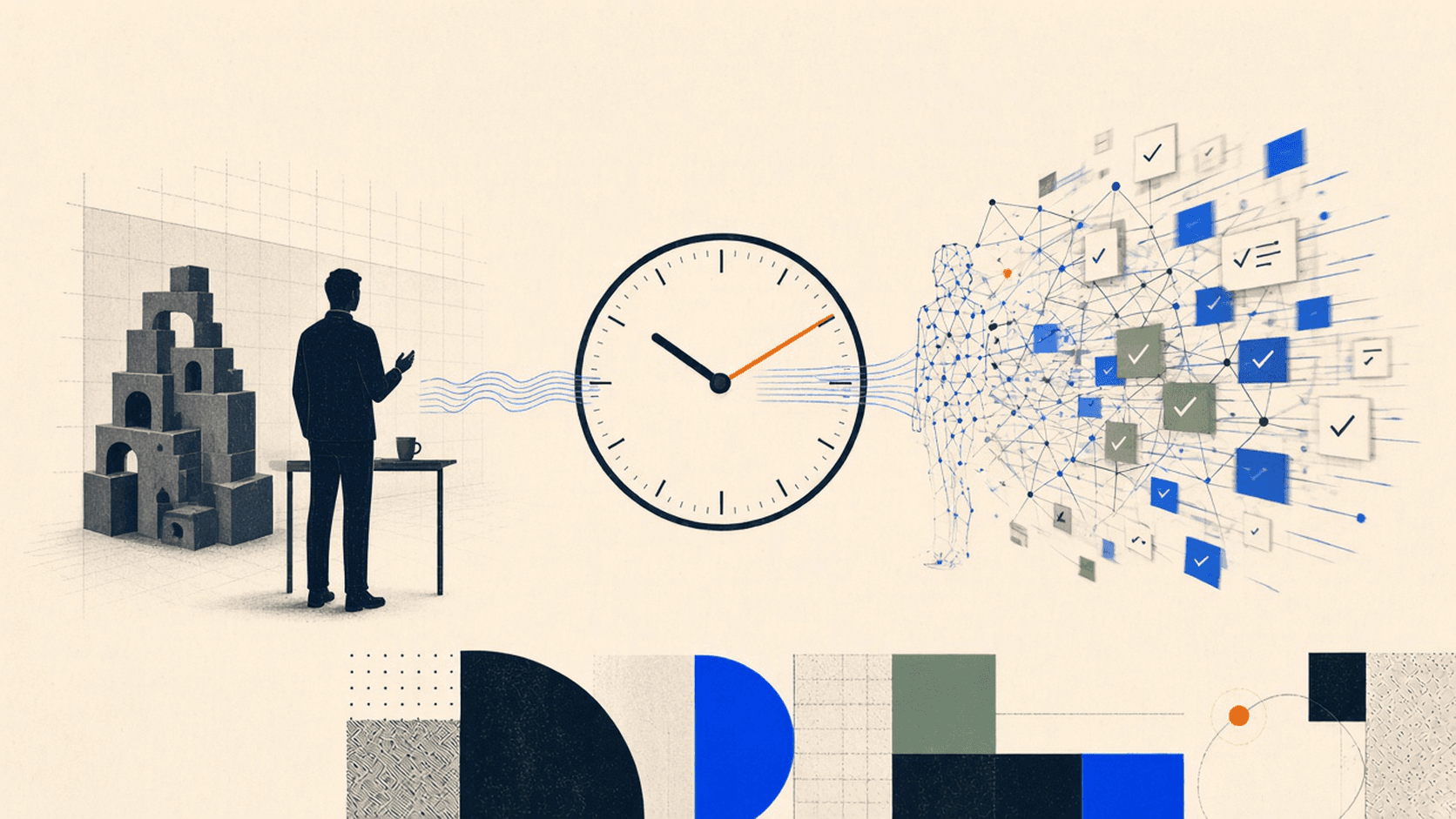
Imagine walking into a classroom where everyone operates a thousand times faster than you. Before you finish raising your hand, the class has discussed the question, written an essay, and started another subject. You are still deciding how to begin your first sentence.
Now reverse the picture. Imagine being the fast one. You ask somebody a question, then wait while their lips seem almost frozen. A brief pause stretches into what feels like an afternoon. Watching them reach for a sandwich becomes a major commitment.
This is a thought experiment about human speed and AI speed. The thousandfold difference is an invented setting for our story, not a scientific measurement of intelligence. There is no single multiplier that compares everything people and AI can do.
But imagining that difference helps explain why using AI can feel extraordinary, frustrating, and strangely confusing, sometimes within the same five minutes.
A swimming pool favors a dolphin
Inside our imaginary AI world, information moves like a movie on fast-forward. Possible answers appear, calculations run, and digital work progresses while a human visitor struggles to keep up.
Suppose one particular task takes a person fifteen minutes. At a thousand times the speed, it takes the machine nine-tenths of a second. The clock barely advances, yet the work is already waiting on the screen.
The visitor might feel slow. That feeling would reveal little about their worth, creativity, or ability to make good decisions. It would tell us that the task and environment favor the machine.
A swimming pool favors a dolphin. A staircase changes the competition.
AI comparisons deserve that same attention to setting. Drafting a paragraph, solving a defined puzzle, repairing a bicycle, and rebuilding somebody's trust are different challenges. Speed in one cannot simply be carried over to the others.
Give me a minute
Now let our fictional AI visit the human world. Give it an imagined sense of time that runs a thousand times faster, and the arithmetic becomes almost comical.
One human second corresponds to about seventeen minutes of its imagined experience. One minute becomes nearly seventeen hours. A ten-minute coffee break stretches to almost seven days.
Your colleague says, “Give me a minute.” Your digital visitor prepares for a very long evening.
Of course, this imagined experience is fiction. We cannot infer that an AI feels impatient, bored, or trapped simply because it performs calculations quickly. Processing speed does not establish consciousness or tell us whether a system experiences time at all.
The useful comparison concerns how much work can happen between human actions. A computer can finish some tasks while we are still opening an application. Other tasks require lengthy processing, external tools, or repeated attempts.
Human life also contains waiting that faster calculation cannot erase. Bread needs time to bake. A delivery van must cover real miles. A conversation sometimes needs silence because somebody is deciding whether they feel comfortable enough to speak honestly.
Superposition is not a chatbot
People often reach for quantum mechanics to describe this strange contrast. The temptation makes sense: quantum physics already challenges our everyday picture of reality.
Superposition describes a quantum state as a combination of possible measurement outcomes. Quantum algorithms also use interference, where contributions can reinforce or cancel one another, loosely resembling overlapping waves on water. These are specific physical and mathematical effects. See IBM's quantum computing explainer (opens in a new tab).
As a creative analogy, imagine possible answers as ripples spreading across a pond. Several patterns can be considered before one answer is presented. That image can help us picture alternatives, but it does not explain how an ordinary chatbot actually computes.
Mainstream chatbots run on classical computing hardware. They do not gain their speed by visiting parallel universes, and considering several answers is not quantum superposition. A fast answer also does not mean time itself has accelerated.
Both the person and the computer remain in the same physical world. What differs is the work completed during the interval.
Forty percent, not a thousand times
Actual productivity research brings this thought experiment back to earth. In a 2023 MIT study, professionals given ChatGPT for particular writing assignments completed them in 40 percent less time, with output quality rated 18 percent higher. The tasks had limitations, including reduced demands for factual accuracy and company context. See the MIT research (opens in a new tab).
That is a meaningful improvement, and considerably more useful for planning than pretending every worker suddenly becomes a thousand times faster.
Applying that percentage illustratively, a thirty-minute task becomes eighteen minutes. The person still reads, judges, corrects, and decides what to do with the result. Machine speed enters a larger human process, where other steps continue to take time.
For founders, this is where the comparison becomes practical. An AI agent might generate ten product ideas while you are making coffee. You still need to decide which problem matters, whose life improves, and whether somebody will pay for the solution.
The same applies to creativity. Producing twenty possible openings for a story gives a writer more material to consider. It does not automatically identify the opening that captures a particular memory or makes a reader care.
Fast generation increases the importance of thoughtful selection. Otherwise, we risk surrounding ourselves with more plans than we can execute and more answers than we can evaluate.
One clock
A useful assistant should also respect the pace of its user. Sometimes the best next step is another calculation. Sometimes it is a short explanation that gives a person enough understanding to make a decision they can stand behind.
My view is that building for the AI era means designing a useful connection between these speeds. Let machines accelerate suitable work. Give people clear choices, evidence they can inspect, and enough control to interrupt a mistake before it spreads.
Measure success through completed outcomes: a correct report, a useful product, a customer helped. Count the time spent reviewing and repairing alongside the time saved generating. That measurement habit is part of the thinking behind AiRoyale™. The same connection between machine speed and human judgment is also why Agenie™ is being built around useful agent work, not raw throughput.
The human visitor to AI world should leave with more possibilities. The digital visitor to human world should help turn those possibilities into something that works.
We share one clock. The opportunity is to make the time it measures more useful, more creative, and more our own.