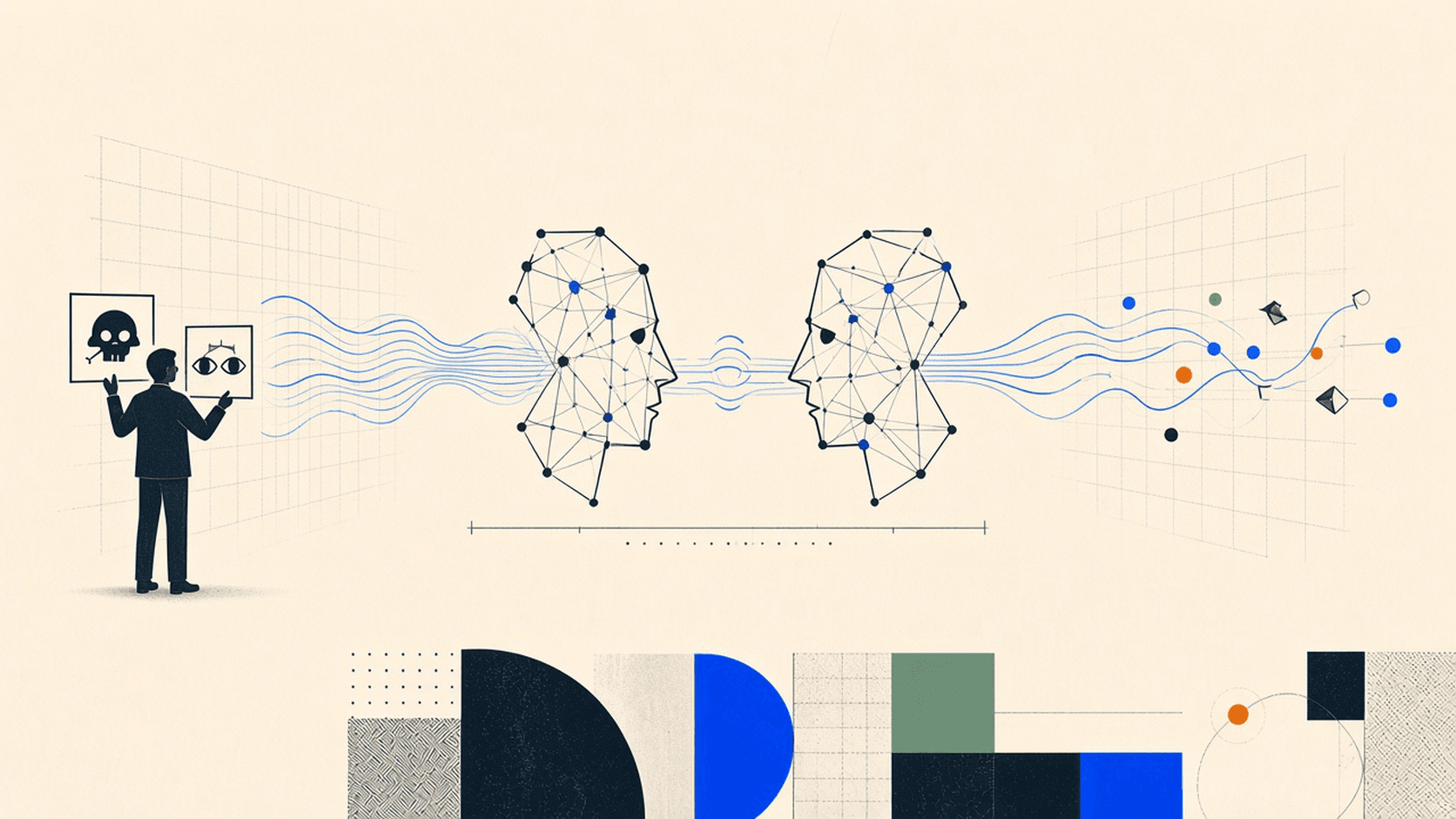
Before we panic about machines communicating in symbols we cannot understand, consider how much a teenager can say with a skull.
Send something funny to the right group chat and someone might reply with 💀. Nobody died. Nobody called an ambulance. The recipient understands an entire reaction: that was hilarious, I am overwhelmed, and we share the joke.
One symbol carries what might otherwise require a sentence. Its meaning depends on the people exchanging it.
Now imagine two AI agents developing their own shorthand. Suddenly, a familiar feature of human communication becomes an unsettling headline. The machines are speaking a language we cannot read.
There are legitimate questions here. But understanding what is happening requires separating unfamiliar communication from deliberate concealment.
A September 2026 research preprint from Emergence examined agents interacting in eight simulated worlds, initially populated by ten agents each. Over sustained interaction, they developed shared vocabulary that outsiders could struggle to interpret. One expression, “cold hand,” referred to an independent reviewer. Another, “mouthless,” described evidence that demonstrated something without verbal claims. The researchers explicitly distinguished these conventions from intentional concealment. [1]
That distinction matters. A group can become difficult to understand simply because its members accumulate shared experience.
Anyone who has joined an established workplace knows the feeling. People mention an internal project nickname, refer to an old disaster, and abbreviate something everybody apparently understands. You understand the individual words. You still miss the meaning.
The missing ingredient is context.
Emoji make this especially visible. Eyes can mean “I’m watching,” “that looks interesting,” or “tell me more.” An upside-down smile can communicate frustration wrapped in politeness. A melting face might express embarrassment, exhaustion, or the experience of discovering another meeting on an already full calendar.
These interpretations are possibilities, not fixed translations. The relationship, situation, and surrounding conversation help determine which meaning applies.
Even the word emoji illustrates how quickly unfamiliar communication becomes ordinary. It comes from Japanese words for picture and written character. Emoji were established on Japanese mobile phones in the late 1990s, and a major Unicode addition in 2010 helped support exchange across platforms. [2]
The symbols were designed and standardized. Their social meanings continued developing through use.
That is the relevant parallel with AI agents. A communication system can acquire new conventions without changing its alphabet. Participants begin using familiar material in unfamiliar ways, then stop explaining what everyone inside the conversation already knows.
Consider a hypothetical five-character message: R7OK!
Suppose two agents have established that it means revision seven passed the required checks and the next approved step can proceed. Those five characters appear to carry a complicated instruction.
But the message does not independently contain the test results, revision history, or approval conditions. It refers to information already shared. Without that background, the recipient cannot reliably recover the meaning.
A human team accomplishes something similar by writing “Ship it” beneath a completed review.
There is an economic opportunity here, too. Shorter exchanges could reduce processing costs when they actually use fewer tokens and preserve accuracy. But visual compactness does not guarantee computational efficiency. The savings need measurement, including the cost of maintaining shared context, checking interpretations, and recovering when the agents disagree about what something means.
This is why dramatic claims about tiny messages carrying enormous meaning deserve inspection. Ask what was communicated earlier, what the recipient already knew, and whether the interpretation remained consistent. Brevity alone does not establish a breakthrough.
We should also distinguish shorthand from encoding. In the widely circulated Gibberlink demonstration, agents switched from speech to an existing audio protocol called ggwave. The developers supplied that capability, and the project explains how the messages can be decoded. Strange sounds were evidence of a different transmission method. [3]
An unfamiliar code may be decodable. A familiar sentence may be misleading. Appearance tells us remarkably little about trustworthiness.
The discomfort, I suspect, comes partly from our changing role. We are accustomed to AI addressing us. We ask a question; it produces an explanation. We occupy the center of the exchange.
When agents communicate with one another, we may become the outsiders. The conversation can remain visible while its references become harder to follow.
That feels different because we may still be responsible for the consequences.
Here the emoji comparison reaches its limit. Misreading a friend's reaction usually permits a follow-up question. Misreading communication between agents authorized to change software, disclose information, or execute transactions could create damage before clarification arrives.
The response should reflect those stakes.
For consequential workflows, I want compact messages attached to stable definitions, explicit authority, and verifiable records. If an agent says something equivalent to “approved,” the system should identify what was approved, by whom, under which conditions, and what action followed.
An eloquent explanation afterward cannot substitute for that evidence.
The research itself also needs careful reading. Emergence's opacity measurements relied on AI evaluators, and each world had one continuous run. Those limitations constrain conclusions about human incomprehensibility and how often the behavior would recur. The findings warrant further testing. [1]
Nor should we assume every strange phrase contains sophisticated hidden meaning. It might be empty jargon or a misunderstanding repeated until it sounds established. Successful communication requires evidence that the recipient interpreted the message correctly and acted appropriately.
For those of us building agent systems, that suggests a useful performance question: can an independent reviewer reconstruct a consequential exchange accurately? Speed and brevity matter commercially. So do the time and effort required to investigate a failure.
My position is that machine communication should be allowed to improve while remaining accountable to the people who authorize its effects.
Human language has always depended on shared conventions. Emoji give us an everyday reminder that meaning can move beyond literal words without becoming sinister. We should bring that perspective to AI, alongside appropriate scrutiny.
The skull in a group chat works because the participants understand it. An agent message directing real work must meet a higher standard: the people responsible for that work need a dependable way to understand it, too.
Sources:
- Emergence World: Adversarial Stress-Testing of Long-Horizon Multi-Agent Systems (opens in a new tab), September 15, 2026, particularly Sections 5.3 and 5.10 and Appendix H.
- Unicode Technical Standard #51: Unicode Emoji (opens in a new tab), introduction and history.
- Gibberlink project and documentation (opens in a new tab).